What LEE is, in one paragraph.
LEE started from a simple question: how could queer youth find someone to talk to when the right support wasn't available around them? The concept was anonymous, 1-on-1 mentoring with experienced adults and allies from the LGBTQ+ community — creating another way to reach out when local support wasn't an option.
§ 02 — Five barriersFive things standing between queer youth and the help that already exists.
Five things standing between queer youth and the help that already exists.
We wanted to understand what made it difficult for queer youth in Germany to access existing support. Across surveys, interviews and desk research, five recurring barriers emerged.
The distance to the nearest queer center.
Most LGBTQ+ centers in Germany are city-based. From a smaller town, accessing support can mean considerable time and travel.
When home isn't a safe place to ask for help.
For some young people, reaching out to family or asking for support at home may not feel like an option.
Finding someone who understands.
Trusted role models and people with similar experiences can be difficult to find, particularly outside larger queer communities.
Support that doesn't meet young people where they are.
Existing organisations offer valuable support, but their digital presence doesn't always reflect how younger people look for information and connect today.
The distance between a public group and a private conversation.
Social media can provide community, but privacy concerns, cyberbullying and exposure can make it difficult to speak openly about personal issues.
Not a competitor. A bridge.
LEE had no direct competitor in Germany, but there were already organisations doing important work in counselling, education and specialised support. Rather than treating them as competitors, we looked at where LEE could complement what already existed — and where there was still a gap.
One of those gaps was digital access. Most counselling and mentoring at the time still assumed a visit in person. Existing support wasn't always easy to reach for young people living outside larger cities, those who didn't feel comfortable seeking help in person, or those looking for a more private and anonymous way to talk to someone. LEE was designed to offer another point of access.
That meant LEE could play different roles. For some, anonymous mentoring could be the support they needed. For others, it could be a first step towards an organisation offering more specialised or professional help. Mapping these scenarios helped us define where LEE could stand on its own — and where it should connect people to existing support.
Target group · Queer youth · Gen Z
"I only have a few questions to ask. Online & anonymous would be easy."
"I live in the countryside — it's hard to travel to the city for regular consultation."
"I don't dare to take the first step. Online & anonymous would be motivating."
"My family doesn't support me. An online, anonymous and safe environment would help."
"I want to manage this area of my life online, just like everything else."
LEE
When would young people (need to) leave the digital space?
- Prefer mentoring online and/or anonymous.
- Have difficulties going to an organization in person.
- In a dangerous or difficult situation and needing more professional help.*
Partner organisations
abqueer
abqueer.de- Educational events from age 10.
- Advice, seminars and workshops for teachers and educational professionals.
GLADT
gladt.de- LGBTQ people of color & migrant history.
- Advice on coming-out, family, civil-partnership law, health, violence.
- Committed against racism, sexism, trans*- and homophobia.
Gleich & Gleich
gleich-und-gleich.de- Assisted living for LGBT youth and young adults.
- Family support and individual supervision.
"Support doesn't end with the app. LEE is a stepping stone, not a destination."— The principle behind the ecosystem map
Two surveys, run in parallel.
LEE had to work for two sides at the same time: the young person seeking support and the mentor offering it. We ran two surveys in parallel to understand what each side needed — and, importantly, where those expectations aligned.
We used overlapping questions around communication, response times and what each side needed to feel comfortable and prepared.
Two groups, surveyed in parallel
Deliberately overlapping questions
Compare expectations
Identify matches and gaps
Mentees · Queer youth · 8 respondents
Privacy and anonymity mattered.
- 88% Would use the app — two named conditions: maximum data security, and one consistent mentor rather than rotating people.
- 100% Chose written messaging. Phone calls followed at 75%, voice messages at 50%.
- 63% Wanted a reply every two to three days.
- 50% Had never asked for support at all. Of those, most said they didn't dare take the first step; the rest would have preferred to ask anonymously or online.
Mentors · Adults & allies · 37 respondents
Willing, but new to this. Support materials matter.
- 84% Preferred written communication; 65% were also open to voice, video or meeting in person.
- 97% Had volunteering experience — but 60% had never mentored, and only 5% had mentored online.
- 84% Asked for a handbook of possible responses. Emergency contacts (81%), training on specific topics (70%) and peer exchange (68%) followed closely.
-
30—90
min/wk Realistic weekly commitment for most, with 75% willing to respond two to three times a week.
From research to the people we designed for.
The survey findings and desk research helped us turn recurring needs and situations into proto-personas we could use throughout the design process. Because LEE had to work for both sides of the mentoring relationship, we created them for mentees and mentors.
Five different situations, rather than one typical mentee.
The mentee personas reflected different situations that could shape why and how someone might seek support through LEE.
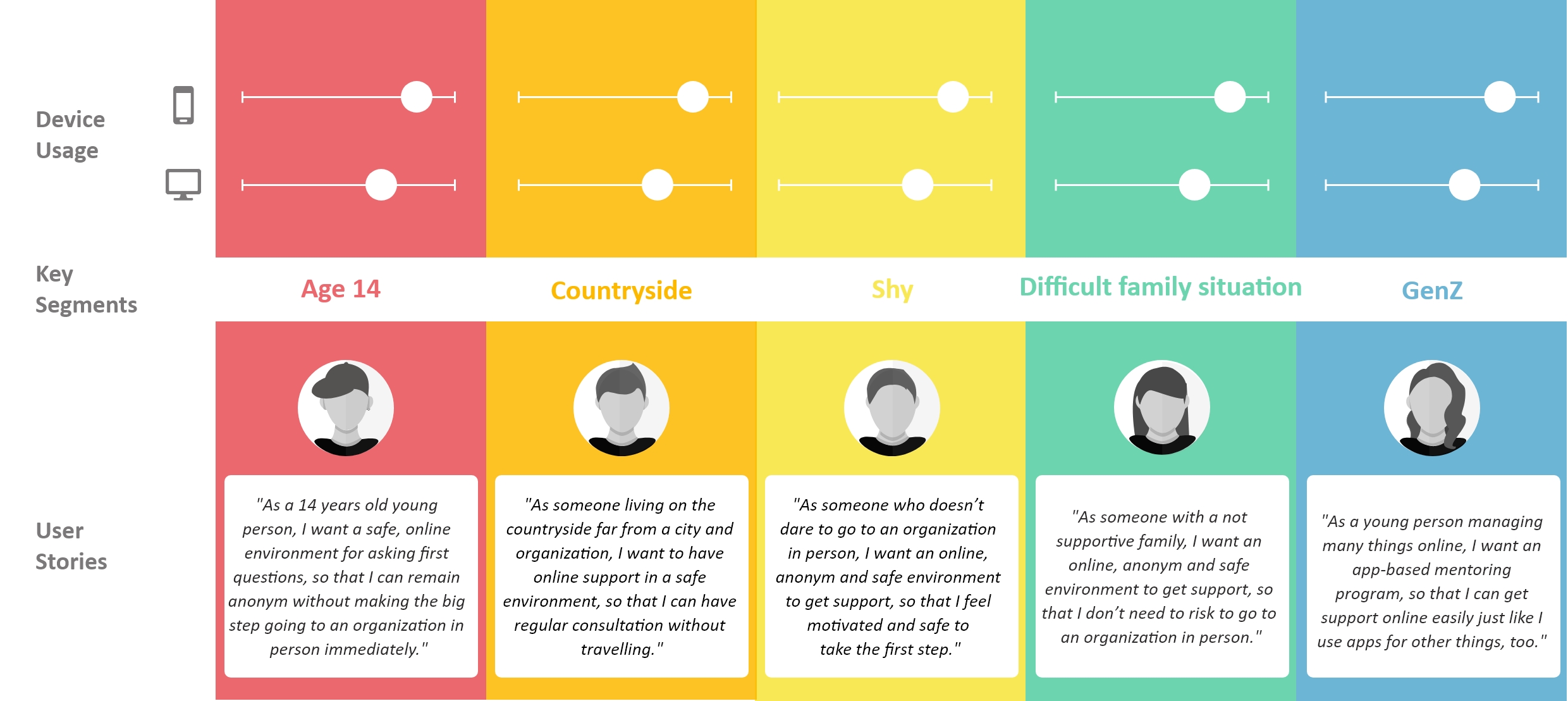
Different experience, different support needs.
For mentors, the main difference was their previous experience — from being completely new to mentoring to having mentoring experience, but not in a digital setting.
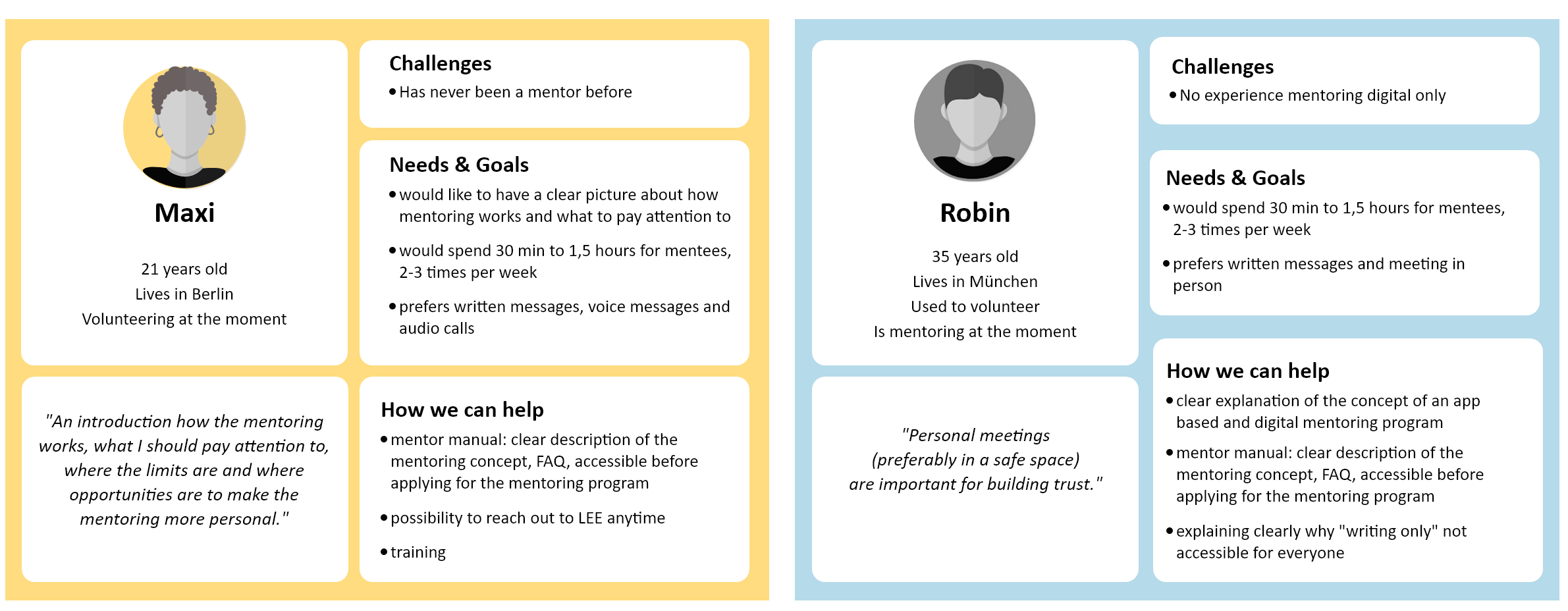
Maxi · New to mentoring
Needs guidance on how mentoring works, what to pay attention to and where the boundaries are.
Robin · New to digital mentoring
Already has mentoring experience, but needs clarity around how mentoring and building trust work in a digital setting.
From the research, five things became non-negotiable.
Each of these five design decisions is anchored in a specific research finding. They aren't best-practice borrowings — they're what the surveys forced us to do.
Chat first.
Insight · 100% of mentees named messaging as preferredThe default mode was text-based, asynchronous, and message-based. Voice and video remained options — but no part of the product required a user to talk in real time.
A named response window.
Insight · mentees expected replies in 2—3 daysRather than hide the asynchronous reality, we set it as a visible expectation in both onboarding flows. No silent waits; no anxious checking.
Mentor onboarding as scope-setting.
Insight · only 5% of mentors had done online mentoring beforeA structured onboarding flow that named time commitment, what mentoring is (and isn't), and where mentors should hand off to professional resources.
A handbook, not a tooltip.
Insight · 70%+ of mentors asked for written supportWe treated the mentor handbook as a first-class product surface, not a help-center page. Scenarios, language, escalation paths. Accessible from inside any conversation.
Anonymity, foregrounded.
Insight · trust is the precondition, not a featureAnonymity wasn't a setting buried in preferences. It was the first thing the onboarding flow said, in plain language, before asking for any information at all.
Five distances in.
Five decisions out.
Where trust is built — or quietly lost.
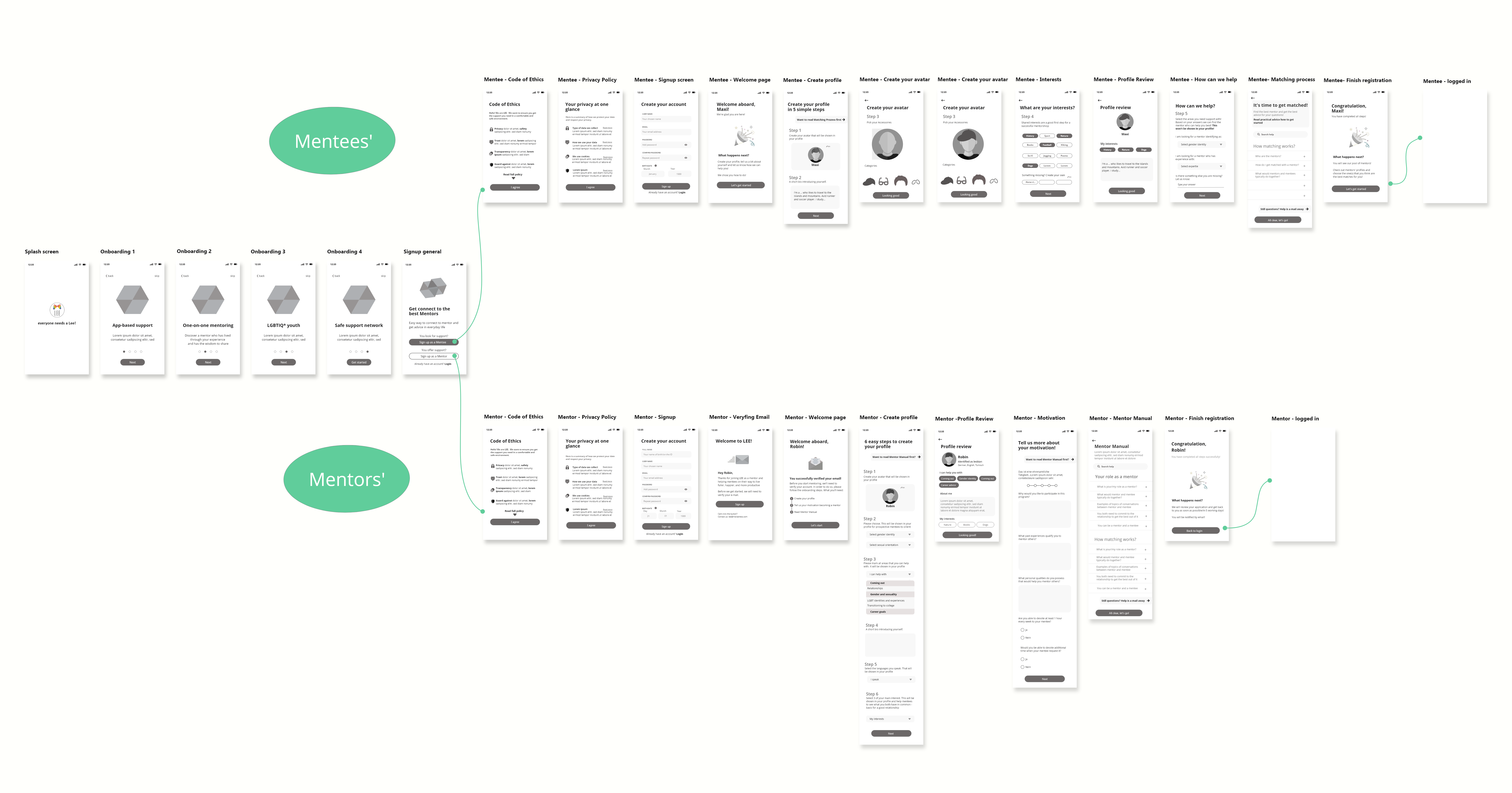
Onboarding carried most of the weight. It is where trust is either established or quietly lost, well before anyone writes their first message — and it had to do that twice, because mentees and mentors arrive with different questions.
One entry point, then two branches: mentees through interests and matching, mentors through motivation, the handbook and verification.
As this portfolio is newly rebuilt, this case study is still being filled in — the mentorship flow, learnings, and a closing note are on their way.